
St. Augustine
The First Archbishop of Canterbury

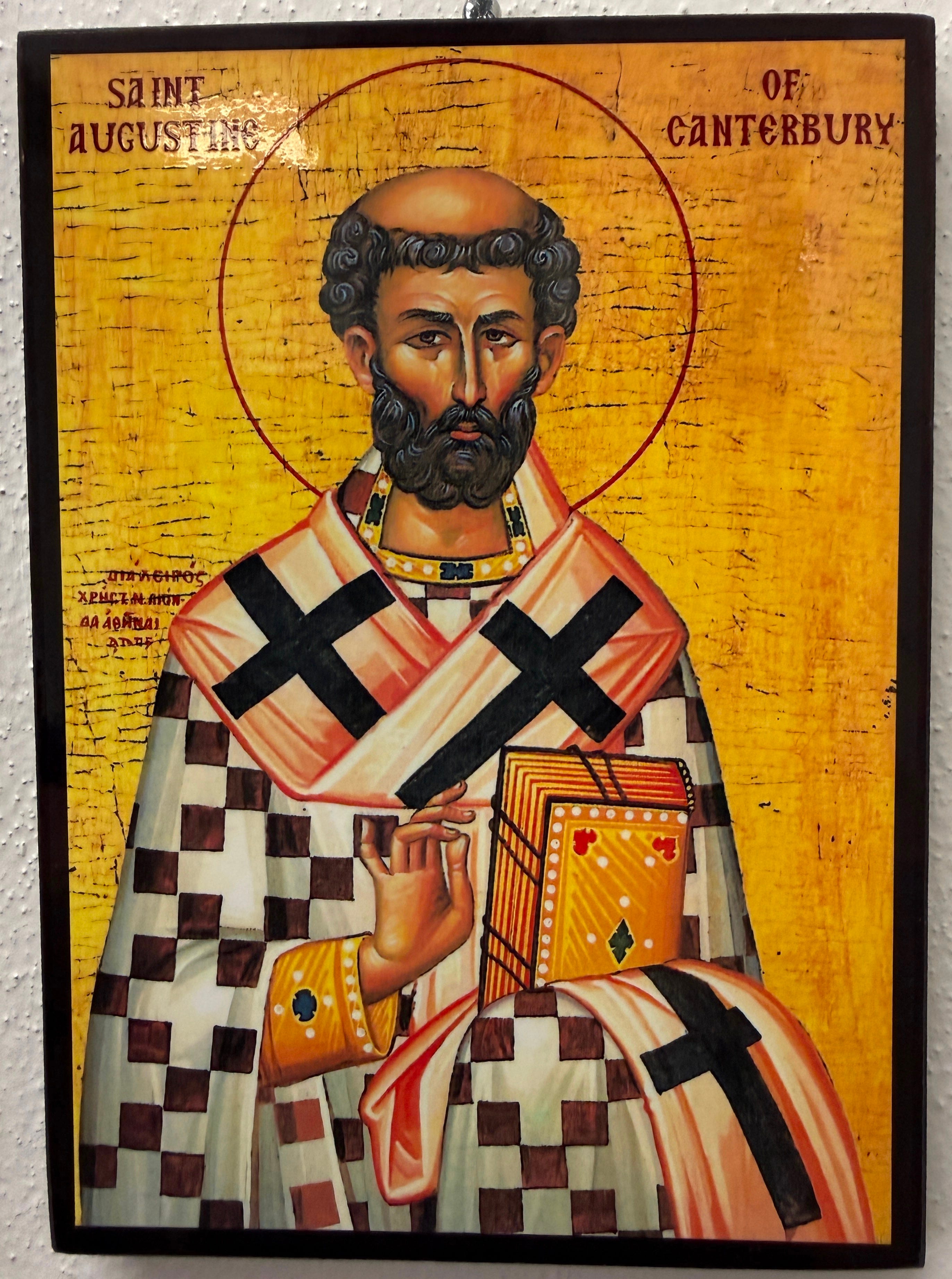
O Lord our God, who by your Son Jesus Christ called your servant Augustine to preach the Gospel to the English people: We pray that all whom you call and send may do your will, bide your time, and see your glory; through the same Jesus Christ our Lord, who lives and reigns with you and the Holy Spirit, one God, for ever and ever. Amen.
When I visited Canterbury last summer (I shared a few of my pictures below), I did some reading about its history, which would not have been nearly as significant without the arrival of St. Augustine. Sent by Pope Gregory I to convert the Anglo-Saxons in England to Christianity, Augustine—a monk and prior of his monastery—landed in Kent in 597.
One of the first things he did was send messengers to King Æthelberht to announce his arrival and seek a meeting with him. Augustine and the forty or so monks who accompanied him then made a procession toward the king. Henry Offley Wakeman, in An Introduction to the History of the Church of England, described it this way:
At its (the procession’s) head was carried a large silver cross, and by the side of the cross a picture of Christ Crucified, painted on wood. Behind, with ordered step, came the band of missionaries, singing litanies as they walked. At the end of the procession the noble form of Augustine himself towered over his companions, and marked him out to the eye as their leader and chief.
Wakeman also quotes an English writer’s account of Augustine’s speech to the king, given while he stood with the cross and image, stating, “He told how the tender-hearted Jesus by his own throes had redeemed the sinful world, and opened the kingdom of heaven to all believers.”1
Augustine found favor with the king, even though Æthelberht had no interest in Christianity at the time. However, the king’s wife, Bertha, had converted to Christianity across the Channel before Augustine’s arrival and is thought to have exerted at least a little pressure on him to convert. It wasn’t long before King Æthelberht was baptized.
From then on, Christianity began to spread rapidly in England—though it should be noted that some Celtic Christians were already present in the western parts of the country when Augustine arrived. With the rapid growth, Augustine soon became bishop.
There is definitely much more to say about St. Augustine and his impact on England and beyond, but, on this his feast day, I wanted to share a little of what I learned2—and vacation pictures!— about his work of starting the English Church and about Canterbury Cathedral while I was there.


Wakeman, Henry Offley, An Introduction to the History of the Church of England: From the earliest Times to the Present Day, Eleventh Edition. Rivingtons, 34, King Street, Covent Garden, London. 1927. p.11.
Another book I was reading at the time was Edward Rutherford’s book, London. (You can find a copy here) It is historical fiction but the author’s history of the time between Roman occupation of England to the arrival of Augustine was informative, kept close to historical sources) and helped me immerse a bit into the history in a different way.